- Utilitzar la forma correcta de there is / there are amb some o any.
- Conèixer els verbs que van seguits de la forma +ing.
- Distingir l'ús del present simple i el present continu.
- Conèixer i utilitzar el passat simple dels verbs regular i irregulars en les seves formes afirmativa, negativa i interrogativa.
- Formar el passat continu en oracions afirmatives, negatives i interrogatives.
- Conèixer i formar el futur amb will i going to.
- Formar les formes comparatives i superlatives dels adjectius.
- Comprendre informació global i específica d'un text escrit. (reading)
- Descriure esdeveniments en passat i en futur. (writing)
dijous, 13 de juny del 2013
CONTINGUTS EXAMEN FINAL

dijous, 2 de maig del 2013
CAN / COULD
ACTIVITES:1. http://www.englishexercises.org/makeagame/viewgame.asp?id=3826
2. http://www.english-zone.com/verbs/can-cant.html
3. http://mbonillo.xavierre.com/exercises/eso2/2esowint09/cancould2eso3.htm
4. http://www.detailenglish.com/index.php?page=forum&op=viewThread&id=86&title=Can---Cant---Could---Couldnt-Exercise
COMPARATIVE AND SUPERLATIVE ADJECTIVES
ACTIVITIES:
dimecres, 20 de març del 2013
object pronouns
OBJECT PRONOUNS
| Personal Pronouns | Possessive Adjectives and Pronouns | Reflexive Pronouns | ||
|---|---|---|---|---|
| subject form | object form | possessive adjective | possessive pronoun | |
| I | me | my | mine | myself |
| you | you | your | yours | yourself |
| he | him | his | his | himself |
| she | her | her | hers | herself |
| it | it | its | its | itself |
| we | us | our | ours | ourselves |
| you | you | your | yours | yourselves |
| they | them | their | theirs | themselves |
Here you have some activities about object pronouns:
dilluns, 11 de març del 2013
PAST CONTINUOUS (or Past Progressive)
Form
| Positive | Negative | Question | |
|---|---|---|---|
| I / he / she / it | I was speaking. | I was not speaking. | Was I speaking? |
| you / we / they | You were speaking. | You were not speaking. | Were you speaking? |
Exceptions in Spelling
| Exceptions in spelling when adding ing | Example |
|---|---|
| final e is dropped (but: ee is not changed) | come – coming (but: agree – agreeing) |
| after a short, stressed vowel, the final consonant is doubled | sit – sitting |
| l as final consonant after a vowel is doubled (in British English) | travel – travelling |
| final ie becomes y | lie – lying |
Use of Past Progressive
- puts emphasis on the course of an action in the past
Example: He was playing football.
- two actions happening at the same time (in the past)
Example: While she was preparing dinner, he was washing the dishes.
- action going on at a certain time in the past
Example: When I was having breakfast, the phone suddenly rang.
Signal Words of Past Progressive
- when, while, as long as
ACTIVITIES:
PAST SIMPLE - PAST CONTINUOUS
Form
| Simple Past | Past Progressive |
|---|---|
|
irregular verbs: see 2nd column of irregular verbs
I spoke
regular verbs: verb + ed
I worked
|
past form of 'be' + ing form of verb
I was speaking
you were speaking he / she / it was speaking we were speaking they were speaking |
| Exceptions | |
Exceptions when adding 'ed' :
|
Exceptions when adding 'ing' :
|
Use
After another or at the same time?
Do you want to express that the actions in the past happened one after another or at the same time?| Simple Past | Past Progressive |
|---|---|
|
after another
She came home, switched on the
computer
and checked her e-mails.
|
at the same time
Simon was playing on the computer while his brother was watching TV.
|
New action or already in progress?
If you want to express that a new action happened in the middle of another action, you need both tenses: Simple Past the new action and Past Progressive for the action already in progress.| Simple Past | Past Progressive |
|---|---|
|
new action
My mobile rang (when I was sitting in a meeting.)
|
action already in progress
While I was sitting in a meeting, (my mobile suddenly rang.)
|
Only mentioning or emphasising progress?
Do you just want to mention that an action took place in the past (also used for short actions)? Or do you want to put emphasis on the progress, e.g. that an action was taking place at a certain time?| Simple Past | Past Progressive |
|---|---|
|
just mentioning
Colin played football yesterday.
|
emphasising progress
Yesterday at six o'clock, Colin was playing football.
|
Certain Verbs
The following verbs are usually only used in Simple Past (not in the progressive form).- state: be, cost, fit, mean, suitExample: We were on holiday.
- possession: belong, haveExample: Sam had a cat.
- senses: feel, hear, see, smell, taste, touchExample: He felt the cold.
- feelings: hate, hope, like, love, prefer, regret, want, wishExample: Jane loved pizza.
- brain work: believe, know, think, understandExample: I did not understand him.
- introductory clauses for direct speech: answer, ask, reply, sayExample: “I am watching TV,“ he said.
Signal words
| Simple Past | Past Progressive |
|---|---|
|
|
ACTIVITIES:
dimecres, 9 de gener del 2013
Past simple
PAST SIMPLE ACTIVITIES.
BE.
http://www.ego4u.com/en/cram-up/grammar/simple-past/exercises?03
REGULAR VERBS.
http://www.bradleys-english-school.com/online/speedword/spdwrdpast1.html
http://www.adelescorner.org/grammar/past_tense/past_regular.html
http://www.englishexercises.org/makeagame/viewgame.asp?id=5114
IRREGULAR VERBS.
http://www.english-grammar-lessons.com/irregularverbs/exercise4.swf
http://www.ego4u.com/en/cram-up/grammar/irregular-verbs/exercise?0
http://www.ego4u.com/en/cram-up/grammar/irregular-verbs/exercise?1
MIXED.
http://elt.oup.com/student/project/games/pr2game3?cc=global&selLanguage=en
http://www.ego4u.com/en/cram-up/grammar/simple-past/exercises
http://www.englishexercises.org/makeagame/viewgame.asp?id=4920
http://www.englishexercises.org/makeagame/viewgame.asp?id=6075
http://www.englisch-hilfen.de/en/exercises/questions/simple_past2.htm
http://www.englishexercises.org/makeagame/viewgame.asp?id=5837
http://www.englishclub.com/grammar/verb-tenses_past_quiz.htm
EXTRA EXERCISES.
Explanation and exercises: http://www.learnenglish.be/gr2_pasi_study.htm
Messi's profile: http://www.englishexercises.org/makeagame/viewgame.asp?id=2160
J. K. Rowling: http://www.englishexercises.org/makeagame/viewgame.asp?id=2316
http://www.groovetoenglish.com/timeline.htm
http://www.myenglishpages.com/site_php_files/grammar-exercise-simple-past.php
Game: http://www.marks-english-school.com/games/b_past.html
How to talk about the past: http://chagall-col.spip.ac-rouen.fr/IMG/didapages/pastsimple/index.html
dilluns, 8 d’octubre del 2012

dijous, 27 de setembre del 2012
starter unit revision
HERE YOU HAVE SOME ACTIVITES TO REVISE THE CONTENTS IN THE STARTER UNIT.
1. Fill in the gaps:
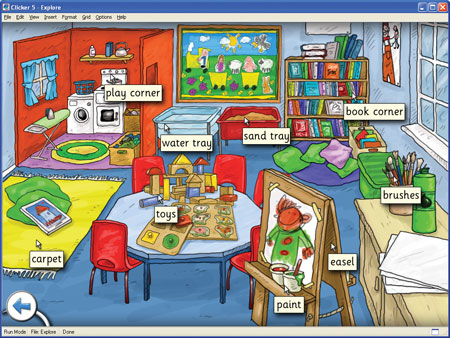
| 1. carpets on the floor.
2. window on the right.
3. chairs around the table.
4. children in the classroom.
5. bike near the play corner.
6. easel next to the sand tray.
7. books on the shelf.
8. water in the water tray.
9. crayons near the window.
10. 5 red cushions on the floor.
11. painting on the easel.
12. big window in the play corner.
13. toys on the table.
|
2. COMPLETE THESE SENTENCES:
1. _______________an old man sitting on the bench in the park.
2. _______________ some students playing football.
3. _______________ any crayons on the desk.
3. _______________ any crayons on the desk.
4. _______________ some books in the library.
5. _______________ a laptop in the cupboard.
6. _______________ an ice cream in the fridge.
7. _______________ some women in the shoe shop.
8. _______________ any students in the sports centre.
9. _______________ some people near the stadium.
Subscriure's a:
Missatges (Atom)